
Pasta is my favorite food in the world — a dish both sublime and comforting, endlessly varied in form, color, and texture. For an Italian cook, making pasta is the very essence of cooking. It’s more than a habit, a tradition, or a duty. It runs deeper than that. It’s art and it’s in our DNA.
In 2009 I discovered to be intolerant to what and had to transition from this abundance of shapes and flavors to a gluten-free diet. This has been a journey full of twists and turns — especially when it comes to pasta.
Although store-bought gluten-free pasta has come a long way, I have deeply missed homemade fresh pasta.
For a long time, I researched, experimented, and discarded one failure after another — until I arrived at today’s noodles. They are the real thing, or at least as real as gluten-free pasta can be.
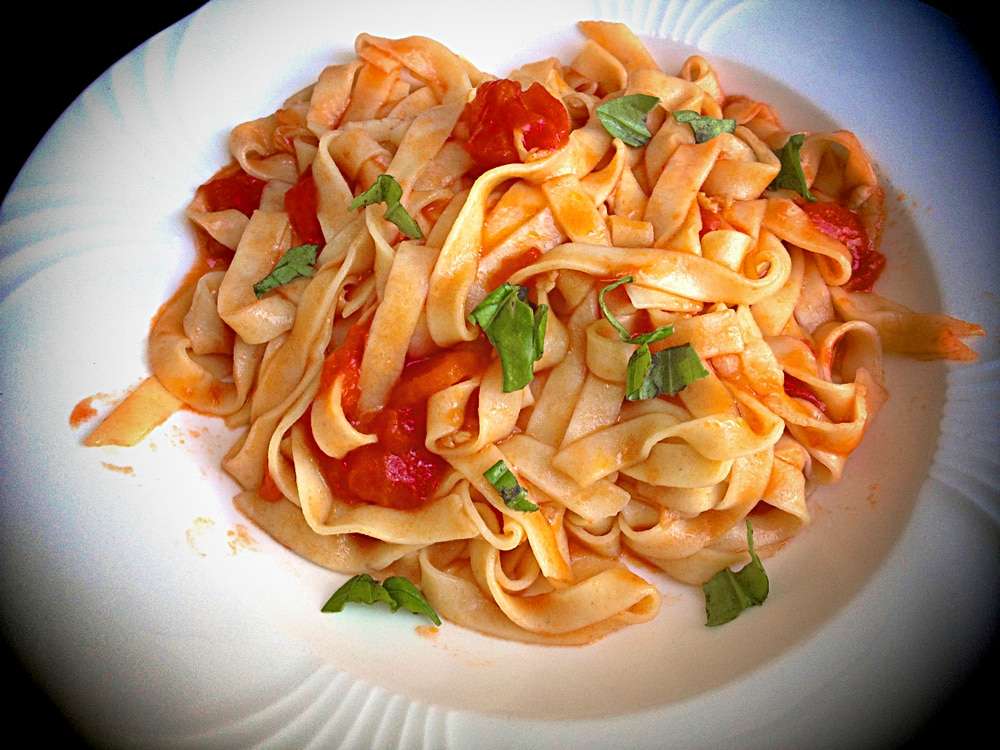
Their flavor is neutral, their texture firm and elastic. They cook without falling apart, even though they’re almost as thin as traditional wheat noodles. You can toss them with any sauce, twirl them on your fork, and lift them from the plate in one smooth, satisfying strand — not in sad little fragments.
If you have never made fresh pasta, please check carefully my tutorials and video here to learn how to make and roll the dough and how to cook and sauce the pasta.
Gluten-free pasta dough is more difficult to handle as it breaks easily and – being not as flexible – is not as forgiving as pasta made with wheat flour. If you cook for others who eat gluten, I advice you to try to make regular pasta a few times to get the hang of the method. Then make gluten-free pasta for yourself.
Recipe
Ingredients
- 35 gr millet flour *
- 170 gr potato starch
- 170 gr corn starch
- 6 gr (2 teaspoon) xanthan
- 1 teaspoon psyllium husks
- 3 eggs
- 2 tablespoon olive oil
*millet flour is used in this recipe to impart a flavor to the dough. You can also use the same amount of rice, corn, buckwheat or other GF flour that you like with the same purpose.
Making the gluten-free pasta dough:
In a food processor, blend all ingredients until the mixture begins to form thick crumbs. Meanwhile heat 1/2 cup water. Depending on the size of the eggs, you will need to add a variable amount of liquid in order to obtain a firm but pliable dough. With the blade running, add the hot water, one teaspoon at the time, until the dough forms a ball. You might need up to 3 tablespoon.
Getting the right consistency is crucial. Too wet, and you will not be able to roll it through the pasta machine. Too dry, and it will break making it impossible to shape it.
Wrap the dough in clingfilm and let it rest at least 30 min. This resting period hydrates the dough and makes it easier to roll it.
Rolling the gluten-free dough:
Set the smooth rollers of a pasta machine on widest setting. Cut the dough into a golf-ball size pieces. Flatten one piece of dough into a rectangle with a rolling pin and feed it through the rollers. To prevent sticking, dust with any fine gluten-free flour you have.
Roll the dough as thin as possible and as quickly as possible. Don’t fold it like you would do with wheat flour. Make sure to keep your pasta sheets relatively short, max 20 cm (8 inch) otherwise they will break in the middle. Minimal manipulation is key to success in this case.
Roll each piece of gluten-free dough 3 times using the widest setting, an intermediate setting and one before the thinnest setting. The dough tends to shred if it’s too thin.
For example, if the settings of your machine are numbered from 1 to 6, roll it at 1, 3 and 5 with 1 being the widest.

Place the pasta sheets on a wooden board or cotton towel to dry. Roll out the remaining dough in the same manner. The pasta should dry – at least 10 min. – before cutting so it will be more robust. You should however prevent it from becoming brittle.
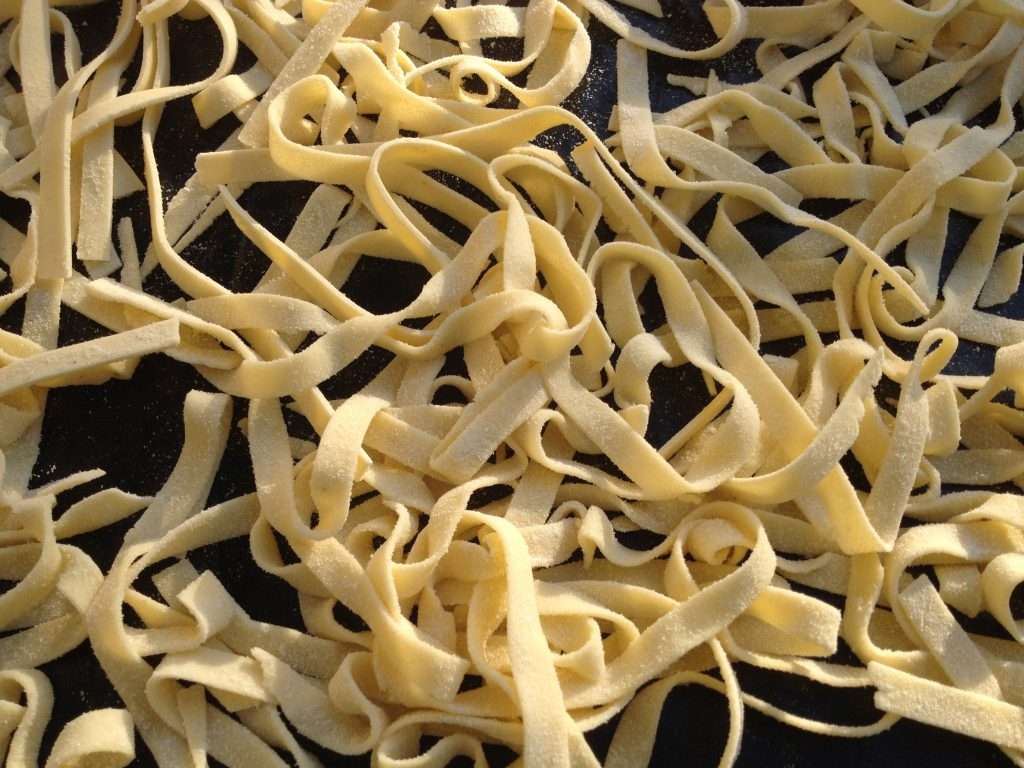
Feed the sheets through a fettuccine cutter and return your beautiful gluten-free noodles to the kitchen towels to dry until ready to cook.
Serves 4
Notes:
Since writing this article in 2013, gluten free flour has very much improved. To make this dough, you can use – per person- 100 g of your favorite gluten-free flour for bread, 1 egg and 3-4 teaspoons hot water to make the dough described above. If you use a commercial gluten-free flour there should be no need to add xanthan and/or psyllium husks.
Roll either by hand with a rolling pin or using a pasta machine as described above.
- The original recipe is based on a variation of the GF flour mix used by Felix and Cappera and in turn derived from a recipe of Bette Hagman’s “More from the Gluten-Free Gourmet”.
- If you are celiac make sure to use certified gluten-free ingredients to avoid gluten contamination
- If you have allergies to some of the ingredients make sure to substitute by weight and type of ingredient (e.g. rice flour instead of millet flour, tapioca starch instead of potato starch)
- xanthan and psyllium are used to substitute gluten, check online where to buy them as this is not the same in different countries
- please check my recipe list for lots of suggestion of simple and seasonal pasta sauces


A good recipe to save for the guest who is gluten intolerant.
ciao Francesca, you’ll make that guest very happy!
Looks delicious!I’d like to try it! When I do, I’ll send feedback
Thanks
Isabel
thank you Isabel, I will be happy to know if it works, the more feedback the better for me!
Are corn starch and corn flour two different things? If so, are they ever interchangeble?
Ingredients have slightly different names in different countries so you might want to check lables of those available to you. According to Wikipedia here corn starch and corn flour are the same. However I have a little problem in calling it “flour” as in my mind flours are the result of grinding the whole grain/kernel while starch is obtained by washing it. As a result a pure starch has different properties in baking than a flour.
I agree with you. In my mind, flour and starch are different and have different properties. So, in your recipe, are you using the actual ground whole grain or the starch? The confusion arises because in the U.S., corn starch and corn flour seem to be sold as different items, and I want to make sure I buy the right thing. Thanks for your help.
Hi Joyce, I am using corn starch as the starch obtained from washing the kernels. It’s soft like talcum powder. Most GF flour mixtures are made of a proportion of actual flour (rice, buckwheat, quinoa etc) and a proportion of starches like corn, potato or tapioca starch.
Sorry to hear about your gluten/wheat difficulties, but I can commiserate. I will be trying this recipe – thank you.
Curious if you’ve tried your talented hand at GF bread-making yet?
Hi Terry,
I am used to it by now! It has taken me a while to become completely gluten free but I have accepted it now. I am working hard on bread on a weekly basis but I am not happy with th resulst yet, I will surely publish it as soon as I have something nice!
I will look forward to that!
This recipe looks wonderful! Would this come out the same if tapioca was substituted for the cornstarch?
I would think so!
Thank you so much for the recipe. It makes eating pasta a joy again. Even my gluten eating family enjoys this, which makes cooking much easier. I donʻt have to make two of everything because they enjoy this as much as store bought regular pasta. I use this recipe for lasagna too.
thank you Danielle, I am so glad you enjoy the recipe!